
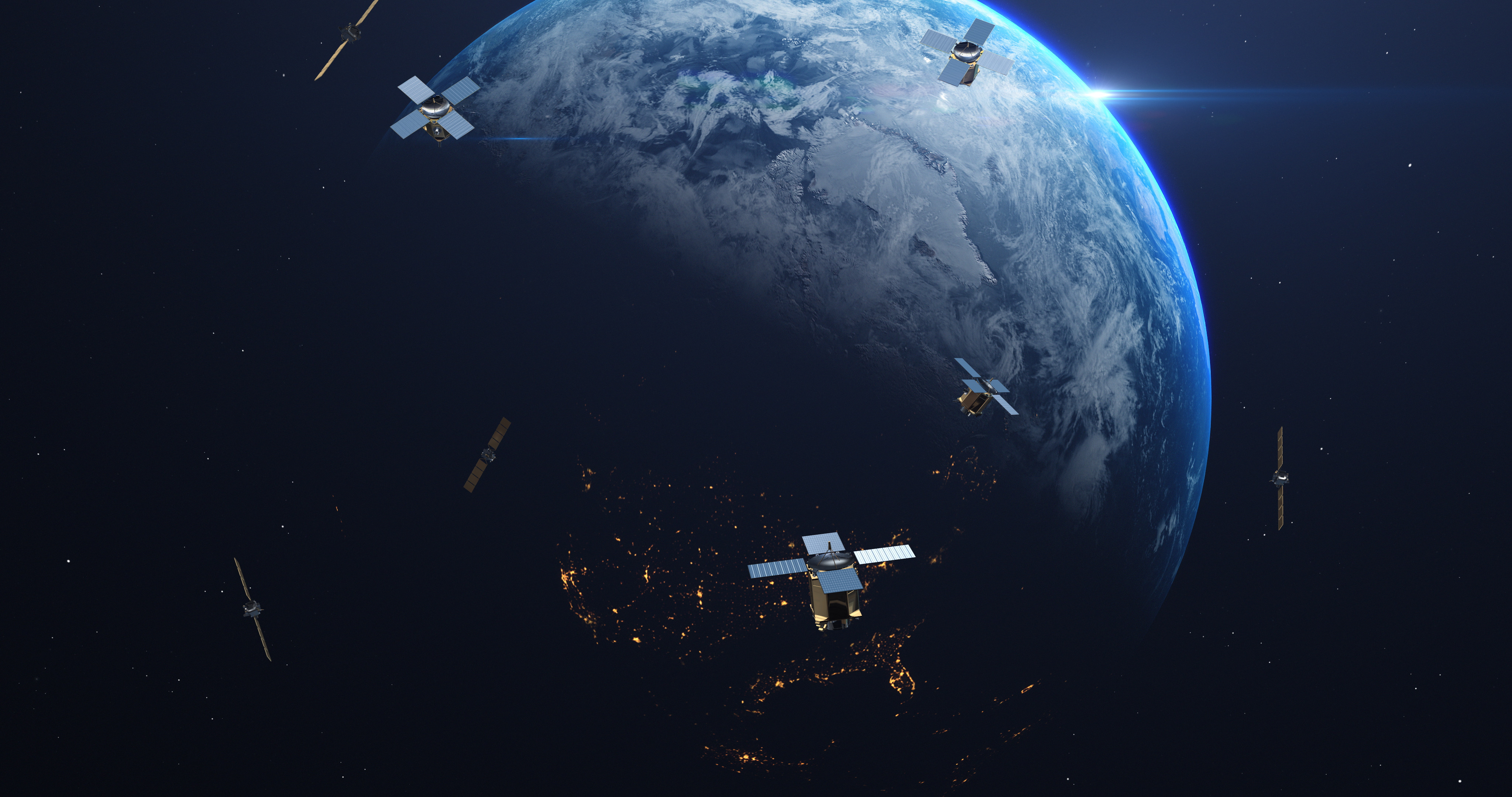

The next great frontier in technology and investment is not just in space, it’s in how the global space economy itself is splitting. A quiet but irreversible transformation is underway: the ecosystem is dividing into two distinct orbits, one led by the United States and its allies, and the other anchored by China and its growing network of commercial partners.
The Shape of a Divided Orbit
The U.S.-led system, built around NASA, SpaceX, Axiom, and Amazon Kuiper, extends across Europe, Japan, India, and Australia. It is characterized by private-sector dynamism, venture-backed innovation, and tight alignment with national-security policy.
In parallel, China’s rapidly expanding ecosystem, centered on CNSA, CASC, GalaxySpace, and iSpace is developing its own launch capabilities, satellite networks, and lunar ambitions through the International Lunar Research Station (ILRS). What was once a state-driven endeavor is now commercially layered, with private launchers like LandSpace, Galactic Energy, and Deep Blue Aerospace achieving cost parity with Western peers. Meanwhile, downstream industries, from precision agriculture to weather analytics and fintech, are driving domestic demand and export potential.
Recent data underscores the speed of this divergence. Global space investment reached a record $3.5 billion in Q3 2025, nearly doubling year-on-year as capital flowed into rocket-makers, low-Earth-orbit networks, and dual-use defense technologies. U.S. startups such as Hadrian, Apex, and Hermeus led the quarter, while China’s Galactic Energy closed a $336 million round, signaling a maturing, two-engine market within the global space economy rather than one dominated by a handful of players.
These systems are diverging not just politically but structurally, with different technical standards, regulatory regimes, and capital channels. The decoupling is accelerating, shaped by export controls, cybersecurity laws, and defense priorities. For investors, the implications are profound: the world is no longer one integrated global space economy, but two independent innovation networks orbiting the same planet.
Where Asia’s Family Offices Fit In
Amid this polarization, Asian family offices are emerging as pivotal bridge capital. A recent survey shows that 18 percent of family-office investors express active interest in space and aerospace, particularly where dual-use or defense technologies intersect with long-term R&D. Capital from Singapore, Hong Kong, Japan, Korea, India, and the UAE enjoys geographic neutrality and cultural fluency, allowing it to navigate both systems. Family offices also have patient, multigenerational capital, ideal for space and deep-tech investments that demand extended development timelines within the global space economy.
These investors can serve as bridge builders, participating in the “corridors” that connect both ecosystems. Neutral hubs such as Singapore, Luxembourg, and the UAE provide financial and legal structures that allow investors to engage in compliant, cross-border opportunities. India offers low-cost launch and satellite-manufacturing capacity, while Japan and Australia bring advanced robotics and quantum-communication capabilities.
Opportunity Amid Fragmentation
While bifurcation introduces duplication and inefficiency, it also drives innovation. Two parallel races, one Western, one Chinese, are pushing advances in AI-enabled satellite analytics, lunar infrastructure, quantum communications, and sustainable materials. This competition could yield breakthroughs that benefit the entire planet, from climate resilience to global connectivity. For investors, understanding these dual dynamics is central to capturing the long-term potential of the global space economy.
For investors, the key is not to pick sides but to structure wisely, maintain separate vehicles and governance frameworks for U.S./allied and China/neutral exposures, conduct dual compliance audits, and diversify across readiness levels (using frameworks such as BRL/TRL) to balance early-stage innovation with commercial maturity. As public space companies like Rocket Lab and Planet Labs double in market value and new entrants such as AST SpaceMobile triple after satellite-to-phone demonstrations, the investable universe continues to broaden.
The Positive View: Bridge Builders as the New Superpowers
If the two space ecosystems continue on separate paths, global collaboration may become more complex, but not impossible. In fact, bridge-building capital from Asia and the Middle East can play a stabilizing and catalytic role, supporting responsible development and ensuring that innovation remains global in spirit, if not in structure.
As one industry leader put it: “The future of space is not bipolar, it’s bifurcated. Those who can operate across both orbits will define the next generation of global capital.”
For family offices, the message is clear: don’t view the split as a barrier, view it as a blueprint for diversification, resilience, and leadership in the most transformational economy of our time.

References
https://www.reuters.com/business/aerospace-defense/investors-pour-record-35-billion-into-space-investors-look-beyond-big-names-2025-10-10/
https://alecandronikov.medium.com/family-offices-have-spoken-investment-trends-2025-4cc000234049
.svg)