
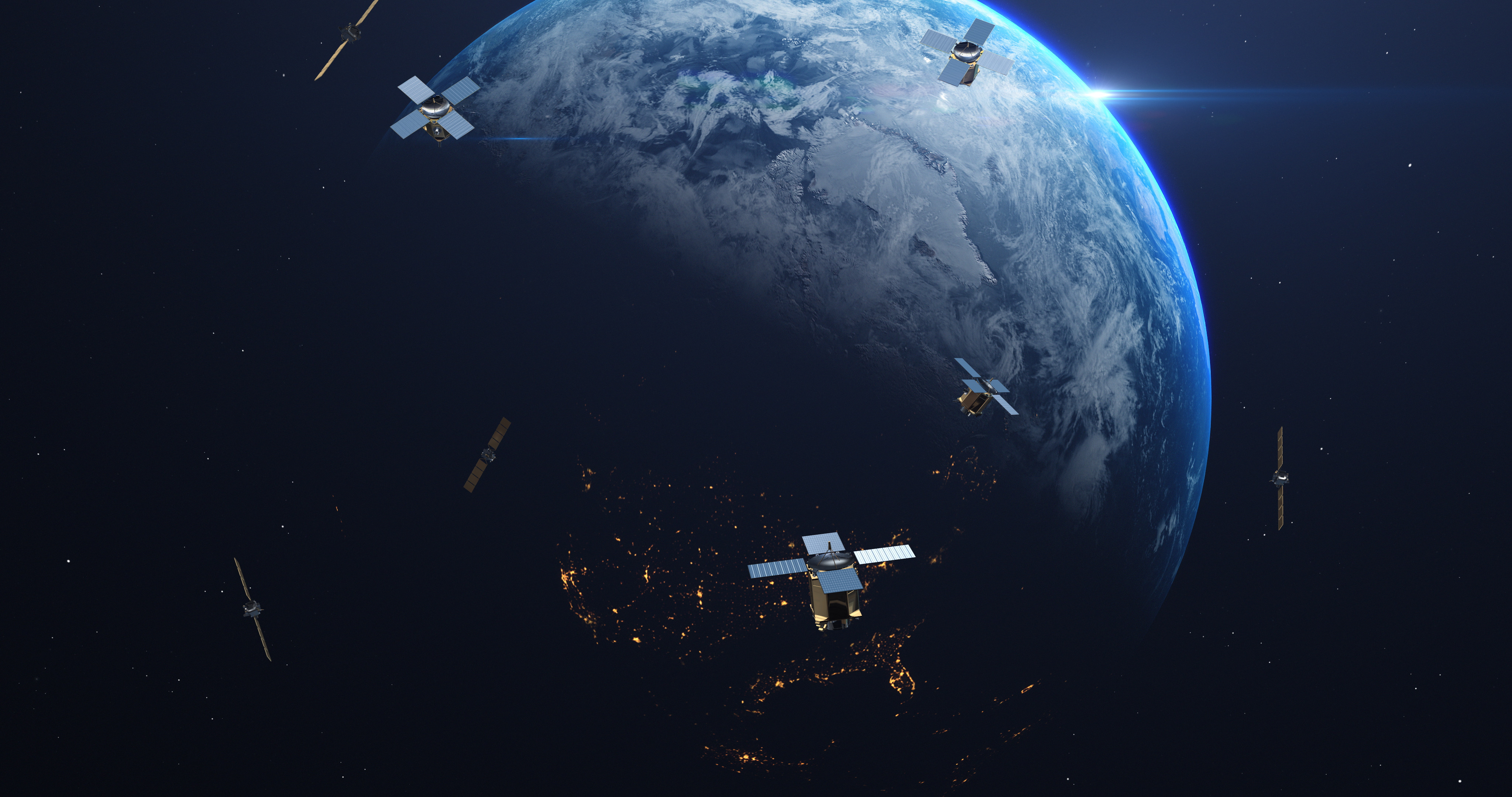

We often talk about space as the next frontier for growth and innovation, but rarely as a source of systemic risk. Yet modern communications, navigation, finance, and logistics are deeply intertwined with space-based infrastructure. Two very different but increasingly discussed scenarios—Kessler Syndrome and a Carrington-class solar storm—highlight why resilience planning matters, and why Hong Kong is actually better positioned than many people might expect.
Kessler Syndrome is essentially a traffic accident problem in space. Low Earth orbit (LEO) is becoming crowded with satellites. If collisions occur, debris can multiply, triggering a chain reaction that makes certain orbital regions too dangerous to operate in. This wouldn’t shut down “all satellites,” but it could significantly disrupt services that rely heavily on LEO—such as some satellite broadband systems, Earth observation, and certain real-time communications links.
A Carrington Event is very different. It refers to an extreme solar storm, like the one recorded in 1859, that sends charged particles toward Earth. If it happened today, it could interfere with satellites, disrupt GPS signals, affect radio communications, and—most critically—damage power grids through geomagnetically induced currents. This is not science fiction; it’s a low-probability, high-impact natural risk.
So what does all this mean for Hong Kong?
The first reassuring point is that Hong Kong does not rely on satellites for most of its international connectivity. Nearly all global internet traffic flows through submarine fiber-optic cables, and Hong Kong is one of the most densely connected hubs in the world, with more than a dozen cable systems landing at multiple sites. These cables link Hong Kong directly to Asia, North America, and Europe. In a Kessler Syndrome scenario—where LEO satellite services are degraded—most people in Hong Kong would barely notice, provided terrestrial networks remain intact.
The real mitigation strategy here is not exotic technology, but diversity and redundancy. Organizations that rely on global connectivity can protect themselves by using multiple network providers, routing traffic through different cable systems, and avoiding single points of failure. Hong Kong learned this lesson the hard way after regional submarine cable disruptions in the past, and much of today’s network design reflects that experience.
A Carrington-type solar storm poses a different challenge. The cables themselves would still work, but power supply and satellite-based services like GPS could be disrupted. In this scenario, resilience depends on how well systems can operate when power is unstable and bandwidth is constrained.
Hong Kong already has some important defenses in place. Telecom exchanges, mobile base stations, data centers, and critical facilities are required to maintain backup power, including batteries and diesel generators. This means that even during extended outages, core communications can continue—at least for a period of time. For banks, exchanges, ports, hospitals, and transport systems, the key question becomes operational rather than technical: What services must stay online, and what can be temporarily scaled back?
This is where “degraded mode” technologies come into play.
During severe disruptions, the most valuable communications are often the simplest. Voice, short text messages, and basic data exchange matter far more than video streaming or real-time dashboards. Technologies that could be deployed or emphasized include:
• Fiber-first connectivity with pre-arranged capacity on multiple routes.
• Microwave and terrestrial wireless backhaul, especially for remote or critical sites.
• Private LTE or 5G networks for essential services, independent of public congestion.
• HF, VHF, and UHF radio systems, using modern digital modes that allow low-bandwidth, store-and-forward messaging when other networks are unavailable.
• Simplified messaging platforms, designed to work with minimal bandwidth and limited infrastructure—modern equivalents of the old telex concept.
• Local data processing and caching, reducing dependence on distant cloud services during connectivity disruptions.
• Non-satellite timing solutions, such as local clocks and terrestrial synchronization, in case GPS timing becomes unreliable.
The old idea of telex often comes up in these discussions, not because we want to revive the machines themselves, but because the design philosophy still makes sense. Telex was resilient because it was simple, text-based, tolerant of delays, and easy to route over multiple paths. Today’s version of that idea is low-bandwidth digital messaging that can travel over fiber, microwave, or radio, and still work when systems are stressed.
The broader lesson from both Kessler Syndrome and Carrington Event scenarios is that resilience is not about one perfect technology. It’s about layers. Space systems are useful, but they should not be the only pillar. Terrestrial infrastructure, backup power, operational planning, and human procedures matter just as much.
For Hong Kong, this is not a story of vulnerability so much as a reminder. The city already has many of the right building blocks. The challenge—and the opportunity—is to consciously design systems that assume disruption will happen one day, and that prioritize continuity over convenience.
Space may be unpredictable, but with thoughtful preparation on Earth, Hong Kong can remain connected when it matters most.
A Call to Action: Planning for Space Risk Starts on the Ground
The purpose of discussing Kessler Syndrome or a Carrington-class solar storm is not to create fear, but to encourage practical preparation. These risks sit in the same category as earthquakes, pandemics, or major cyber incidents: low probability, high impact, and manageable if addressed early.
For government, the priority should be to treat space-related disruptions as part of national critical-infrastructure planning. This means in coordination with China, mapping dependencies on satellites, GPS timing, and international connectivity across transport, finance, utilities, healthcare, and emergency services. Clear coordination between telecom operators, power companies, data centers, and public agencies is essential. Just as importantly, governments should regularly test “degraded mode” operations—asking not whether systems are perfect, but whether essential services can still function at reduced capacity for days or weeks.
For commercial organizations, especially in finance, logistics, aviation, maritime, and data-intensive industries, the starting point is visibility. Many firms are more dependent on space systems than they realize. A simple exercise—identifying which services rely on LEO satellites, GPS timing, cloud connectivity, or uninterrupted power—often reveals hidden vulnerabilities. From there, mitigation is usually straightforward: diversify network routes, ensure backup power and fuel logistics are real rather than theoretical, and design communications that still work when bandwidth is scarce.
Across both public and private sectors, the most important shift is cultural. Resilience should not be treated as a compliance checkbox or a one-off investment. It is an ongoing process of planning, testing, learning, and adapting. The technologies already exist. What is needed now is leadership, coordination, and the willingness to plan for uncomfortable scenarios before they occur.
Space will continue to play a vital role in our economies and societies. But resilience does not come from space alone. It comes from smart choices on the ground—made in advance, calmly, and deliberately.
References
- AI for Research
.svg)